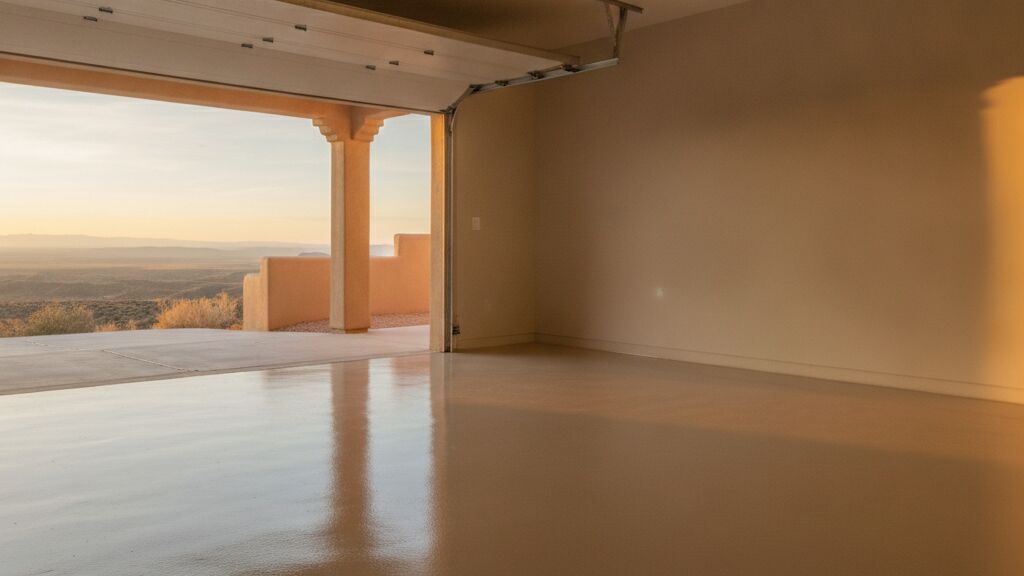
It's tempting to assume any "desert" or "high-altitude" climate stresses concrete the same way. It doesn't. Albuquerque and Santa Fe's high-desert climate puts a different, genuinely distinct kind of stress on a slab than what Denver or Phoenix deal with — and that difference should shape which coating you choose.
Colorado's Front Range gets real winter freezes. Water works into small cracks in concrete, freezes, expands, and widens the crack — a mechanical failure mode driven by ice, and it happens on a seasonal cycle: a handful of freeze-thaw events per winter, not a daily occurrence.
Low-desert Phoenix stays hot for months at a stretch. The stress there is closer to sustained thermal load and UV degradation than a swing — the slab gets hot and stays hot.
New Mexico's high-desert air is thin and dry. That lets a slab heat up fast under intense daytime UV, then radiate that heat away just as fast once the sun goes down. The result is a genuine daily expansion/contraction cycle — commonly 20-30°F between afternoon high and overnight low, widest in spring and fall, and reaching even higher at Santa Fe's nearly 7,200-foot elevation. That's not a once-a-season event; it's hundreds of cycles a year.
A rigid coating that resists water infiltration (Denver's problem) or heat degradation (Phoenix's problem) isn't necessarily built to flex through hundreds of daily expansion/contraction cycles. Polyurea's flexibility and fast cure are a more direct match for New Mexico's specific stressor — a coating engineered to move with the slab rather than fight it.
Curious how this plays out for your specific garage or facility? New Mexico Polyurea can walk through it — reach out for a free estimate.
No obligation. We'll assess your space and give you a real number.